
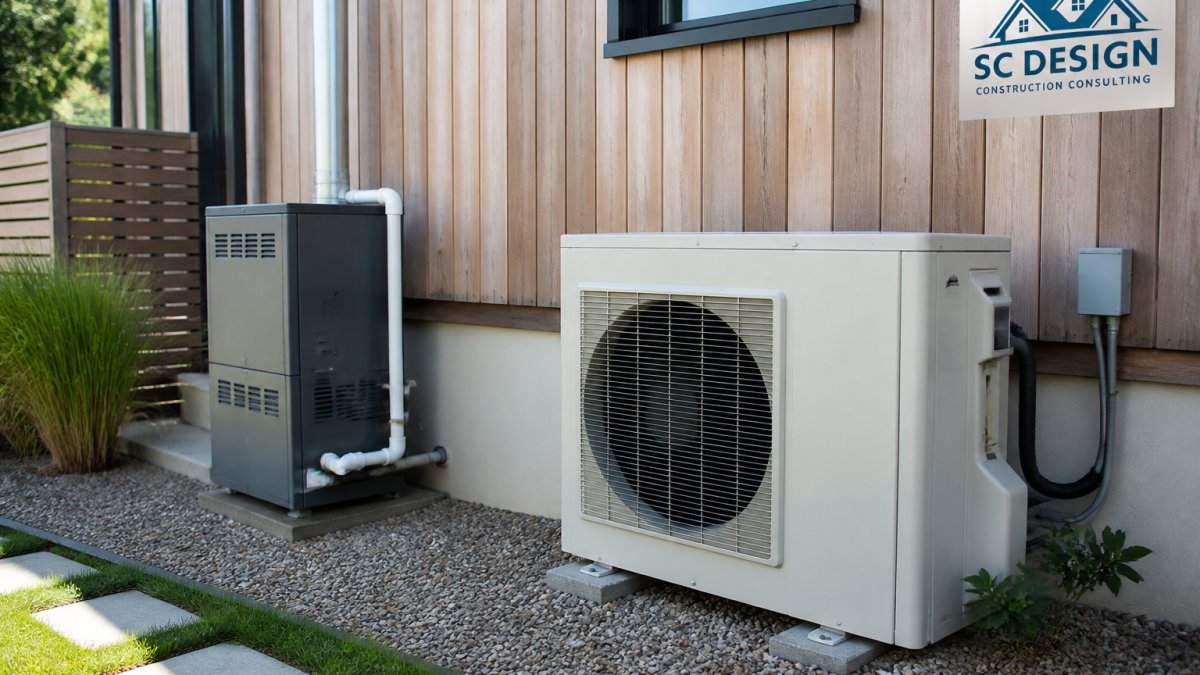
Last Updated: November 1, 2026
Quick Summary
For a Passive House, a heat pump usually beats a furnace because the tiny heating load suits small, modulating equipment, while standard furnaces are typically oversized. The heat pump vs furnace choice still depends on your climate, fuel prices and backup heat needs, so compare whole-life cost rather than upfront price alone.
- Size equipment from a room-by-room Manual J or PHPP load calculation, never from square footage rules of thumb.
- Ask for the minimum turndown ratio, since minimum output limits a Passive House more than rated capacity.
- Consumer Reports notes heat pumps are typically two to four times more efficient than electric-resistance heating or an oil furnace.
- Size backup heat for the gap between cold-weather heat pump output and your design load, not the whole house.
- A dual-fuel setup pairing a cold-climate heat pump with a gas furnace is one practical middle path.
Table of Contents
- Why the Heat Pump vs Furnace Question Is Different in a Passive House
- How a Passive House Heating System Changes the Math
- Heat Pump vs Furnace: Efficiency, Costs and Cold-Weather Performance
- Is a Heat Pump for Passive House the Right Fit?
- Passive House Ventilation and Heating Working Together
- Passive House Backup Heating for Extreme Cold
- Frequently Asked Questions
Why the Heat Pump vs Furnace Question Is Different in a Passive House
The heat pump vs furnace decision changes completely when the house is built to Passive House standards. A conventional home may need a large furnace on a design day. A certified Passive House needs far less, which means many standard furnaces and heat pumps are oversized for the job.
I’ve watched the mechanical room shrink as the building envelope got better. In a Passive House, the envelope does most of the heating work. The equipment you pick matters, but sizing and distribution matter more.
That’s the tension running through this whole comparison. Most heat pump vs furnace guides assume a leaky house with a big heating load. Yours won’t have one.
How a Passive House Heating System Changes the Math
A Passive House heating system is a small, carefully sized heating plant paired with a very tight, heavily insulated envelope and balanced ventilation. The building keeps its own heat, so the equipment only tops up what’s lost. That sounds simple, but it changes every assumption a conventional HVAC contractor brings to the job.
Here’s the mechanism. In a conventional house, the furnace is sized for the coldest design day, and most of the winter it runs at a fraction of that capacity. In a Passive House, the design heating load is so low that the equipment’s minimum output becomes the limiting factor, not its maximum.
A few practical consequences:
- Sizing is driven by the load calculation, not by square footage. A rule of thumb like “so many BTUs per square foot” will oversize a Passive House every time. You need a room-by-room Manual J or Passive House Planning Package (PHPP) load calculation.
- Minimum modulation matters more than rated capacity. A variable-speed heat pump that can turn down to a small fraction of its rated output will run steadily instead of short-cycling. Ask for the minimum turndown ratio, not just the nominal tonnage.
- Distribution shrinks. With a tiny heating load, you need less airflow. Smaller ducts, fewer registers, or even a ductless head or two can carry the whole load. That saves money and ceiling space.
- The ventilation system is part of the heating system. An energy recovery ventilator (ERV) or heat recovery ventilator (HRV) recovers heat from exhaust air and delivers it back to the supply (HVAC Energy Recovery Ventilation). In a tight house, that recovered heat can be a meaningful contributor to heating.
Ask your designer for the design heating load in BTUs per hour and the equipment’s minimum output at the same conditions. If the minimum output is larger than the load on a mild day, you’ll get cycling no matter how efficient the unit is.
If your designer is sizing equipment off a conventional rule of thumb, the numbers won’t fit your house. For the full sequence, see HVAC Design for Energy Efficient Homes: A Step-by-Step Guide. For the full sequence, see .
Heat Pump vs Furnace: Efficiency, Costs and Cold-Weather Performance
On paper, a heat pump wins on efficiency in almost every Passive House. In practice, the answer depends on your climate, your fuel prices, and how much backup you want. Here’s the honest breakdown, with a framework you can actually use.
Upfront Installation Cost and Operating Costs
Costs vary widely by site and equipment, so get itemized quotes for each option. In a Passive House, though, the equipment is small, so the absolute difference in upfront cost is often smaller than in a conventional home.
Operating costs can favor a heat pump, since it moves heat rather than making it. According to Consumer Reports’ heat pump guidance, a heat pump is typically two to four times more efficient than electric-resistance heating or an oil furnace. Consumer Reports also notes that actual savings depend on your circumstances, so I won’t promise a number.
Here’s a practical way to compare whole-life cost:
- Get your local electricity and gas rates from your utility, including any fixed charges and seasonal tiers.
- Estimate annual heating energy from your design load and climate data, not from a national average.
- Apply seasonal performance. For a heat pump, use the manufacturer’s cold-climate rating or a locally appropriate coefficient of performance (COP). For a furnace, use its annual fuel utilization efficiency (AFUE).
- Add maintenance and replacement. Maintenance needs differ between heat pumps and furnaces, so ask your installer for the service schedule for each option. Both have a service life, so include replacement in your math.
- Compare the totals over the same period. A higher upfront cost can still win if operating and replacement costs are lower.
| Factor | Heat Pump | Gas Furnace |
|---|---|---|
| Upfront cost | Higher | Lower |
| Fuel | Electricity | Natural gas |
| Efficiency | Moves heat; 2-4x electric resistance | High-efficiency combustion |
| Cooling | Built in | None, needs A/C |
| Passive House fit | Excellent at low output | Usually oversized |
| Maintenance | Filters, occasional refrigerant check | Annual cleaning and safety check |
Cold-Climate Performance and Temperature Consistency
Modern cold-climate heat pumps hold their output well below freezing. The ACEEE case study on Eversource air-source heat pumps, presented in 2024, tracked in-situ performance from -10°F to 100°F, which tells you the equipment is tested well beyond mild weather. That matters in mountain climates where design temperatures can dip well below zero.
Temperature consistency comes down to modulation. A variable-speed heat pump can run at low output for long stretches, which keeps rooms even. A single-stage furnace tends to cycle on and off, which can be noticeable in a tight house.
Don’t size a heat pump for its rated capacity. Size it for its output at your design temperature, and plan backup heat for the gap. More on that below.
Is a Heat Pump for Passive House the Right Fit?
For most Passive House projects, yes. A heat pump for passive house applications is the natural match because small-capacity, modulating equipment lines up with a tiny heating load.
Where it falls short: extreme cold snaps and rural electric service. If your utility rates are high or your winters are brutal, a dual-fuel setup makes sense.
Best for: tight new builds with modest loads and available cooling needs.
Skip if: you’re on a fuel source you can’t change and want the simplest possible system.
If you’re weighing this for your own build, see the Benefits of Specialized Mechanical Design for Custom Homes.
Passive House Ventilation and Heating Working Together
A Passive House needs balanced ventilation, and that’s the piece most comparisons ignore. An energy recovery ventilator brings in fresh air and exhausts stale air while recovering most of the heat.
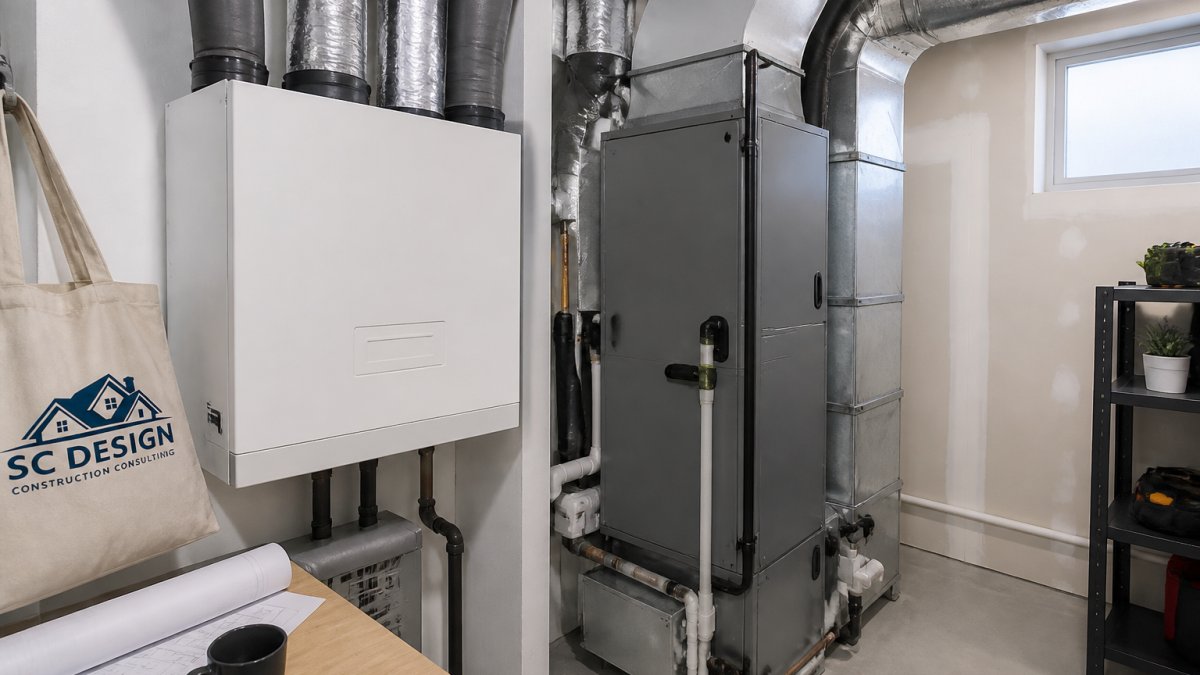
A well-matched pairing of heat pump and ventilation can keep the heat pump running less, while a mismatch can cause ongoing comfort problems. For the wider picture, see A Guide to Mechanical Design for Energy Efficient Buildings. For the wider picture,
Passive House Backup Heating for Extreme Cold
Backup heat is cheap insurance, not a failure of design. Even a well-built Passive House can see a stretch of weather below its design temperature.
Your options:
- Electric resistance strip in the air handler. Simple, low cost, rarely used.
- Dual-fuel with a gas furnace. The heat pump handles most of the year; the furnace covers the coldest days.
- A small dedicated heater in one room as a resilience measure.
Size the backup for the gap between your heat pump’s cold-weather output and your design load, not for the whole house. When you’re ready to move forward, see Get an Energy Efficiency Design Quote: What to Prepare.
Frequently Asked Questions
Does a Passive House need a furnace?
Usually not. A Passive House is built tight and heavily insulated, so its heating demand is a fraction of a conventional home’s. That small load is often met by a heat pump or a small backup heater rather than a full furnace. In very cold climates, some owners pair a cold-climate heat pump with a gas furnace as backup. The right answer depends on your design temperature and how the home was modeled, so confirm the sizing with your designer before you commit to equipment.
Is a heat pump for passive house projects the best choice?
For many homes, yes. A heat pump for passive house use can handle the small heating load and provide cooling and dehumidification in summer, which matters in a tightly built home that holds heat. Savings depend on your circumstances, so the right choice depends on your local fuel prices and climate. In extreme cold, a cold-climate model or a backup heat source keeps things reliable.
Do passive houses need backup heat?
Sometimes. Passive house backup heating makes sense where winter design temperatures drop well below what your heat pump can hold efficiently, or where you want resilience during a power or equipment failure. A small electric resistance element or a dual-fuel setup with a furnace can cover those hours. The goal is a modest backup sized to the small residual load, not a second full heating system.
Can a heat pump heat and cool a passive house?
Yes. A heat pump provides both heating and cooling, and in a highly insulated home the cooling side often matters as much as the heating side. Tight construction and good windows can lead to overheating in summer, so a system that also dehumidifies and moves air helps keep indoor comfort steady. Pair it with your ventilation design so heating, cooling and fresh air work as one system rather than three separate ones.
Planning a project? Steve offers a free, no-pressure consultation. Call 928-444-7447 (Arizona) or 509-607-0300 (Washington), or visit scdesignarchitectural.com/contact/.
