

Table of Contents
- What a Green Energy Consulting Project Timeline Actually Covers
- Renewable Energy Project Development Stages, From Feasibility to Handoff
- Green Energy Feasibility Study Requirements and How Long They Take
- Green Building Certification Timeline: Built Green and Zero Energy Design
- Permitting, Environmental Impact Assessment, and NEPA Review
- Supply Chain Bottlenecks and Regional Regulatory Variance
- Post-Commissioning: What Happens After the Timeline Ends
- Frequently Asked Questions
Last Updated: September 11, 2026
What a Green Energy Consulting Project Timeline Actually Covers
A green energy consulting project timeline is the sequenced schedule of every task, review, and approval a project must clear, from first site walk to final commissioning and handoff. Most project teams underestimate the permitting and supply chain segments, which is where schedules slip hardest.
Here is what matters most before you read further: the timeline is not a single calendar. It is three parallel tracks running at different speeds.
- The technical track covers site investigation, energy modeling, and mechanical design.
- The regulatory track covers permitting, environmental review, and utility interconnection.
- The procurement track covers long-lead equipment, from heat pumps to switchgear.
Miss the sequencing between these three and you get the classic failure mode: a fully designed building waiting on a transformer.
Renewable Energy Project Development Stages, From Feasibility to Handoff
Renewable energy project development stages run in a fixed order, but their durations vary widely by jurisdiction, project type, and whether the project touches the transmission grid or only a distribution feeder. The stage structure below applies to utility-scale work and residential high-performance builds alike; what changes is the length of each stage and which gate is hardest to clear.
A useful way to read the stages is as a series of decision gates. Each stage produces a deliverable, and each deliverable either clears the gate or sends the project back. Teams that treat stages as a checklist rather than a gate sequence are the ones that discover a fatal flaw after they have already spent design fees.
Stage 1: Site investigation, feasibility, and risk-sensitivity modeling
Site investigation comes first and sets the ceiling on everything after it. A feasibility study at this stage combines solar or wind resource assessment, geotechnical review, grid interconnection screening, and a risk-sensitivity model that tests how the project performs if costs rise or incentives change.
Typical duration: several weeks for a straightforward rooftop or brownfield site, two to four months for a greenfield site that needs new geotechnical borings, wetland delineation, or a queue position study (energy.gov). The gate deliverable is a written go/no-go memo with a defensible hurdle-rate comparison, not a slide deck.
Stage 2: Design, procurement, and permitting
Design and permitting run in parallel, not in sequence. While the design team finalizes mechanical systems and energy models, the permitting team files for local approvals and initiates utility interconnection. Procurement starts early for long-lead items.
Typical duration: three to nine months for residential and small commercial, nine to eighteen months for utility-scale (energy.gov). The gate deliverable is a permit set plus a signed interconnection agreement or a confirmed queue position.
A common mistake is waiting for permit approval before ordering equipment. That single decision can add months to the schedule. The practical rule most experienced project managers use is to release long-lead purchase orders once the design has passed roughly 60 percent completion and the equipment specification has two acceptable alternates.
Stage 3: Construction milestones and commissioning
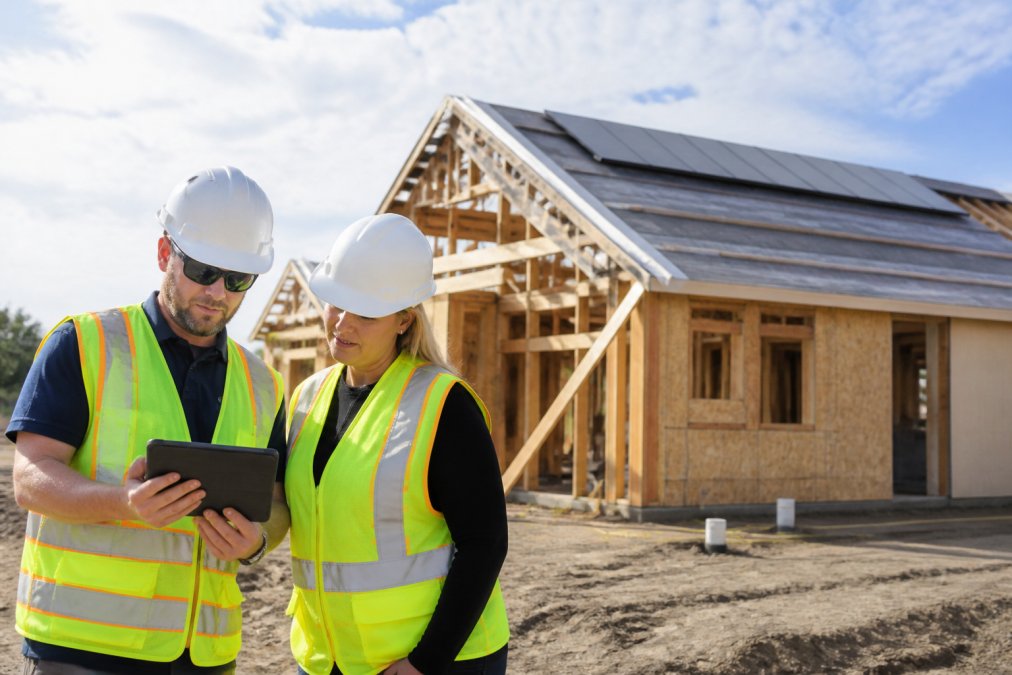
Construction follows a fixed milestone chain: land preparation, foundation, structural, mechanical rough-in, envelope, systems installation, and commissioning. Commissioning is not a formality. It is the verification step where measured performance is compared against the model, and where deficiencies get corrected before handoff.
Typical duration: six to eighteen months depending on scope. The gate deliverable is a commissioning report with measured performance data and a punch list of corrected deficiencies.
Stage 4: Post-commissioning verification and O&M handoff
Most guides stop at Stage 3. The lifecycle does not. After substantial completion, the project enters a verification period, typically the first full heating and cooling season, during which measured energy use is compared against the model under real occupancy. This is also when warranty obligations, performance guarantees, and O&M contracts begin.
Typical duration: twelve months of enhanced monitoring, then a transition to standard O&M. The gate deliverable is a year-one performance report. Skipping this stage is the single most common reason a project that commissioned cleanly still underperforms its model.
How the stages overlap in practice
The three parallel tracks, technical, regulatory, and procurement, do not move at the same speed. A realistic schedule shows the technical track finishing design while the regulatory track is still in utility review, and the procurement track placing orders before either is complete. The overlap is where the schedule either holds or breaks.
DOE project development and finance resources for renewable energy
Green Energy Feasibility Study Requirements and How Long They Take
Green energy feasibility study requirements typically include a resource assessment, a preliminary energy model, a grid interconnection screen, and a financial pro forma. Depending on site complexity and data availability, feasibility work commonly takes several weeks to a few months.
What most guides miss is that feasibility is not a single deliverable. It is a decision gate. If the numbers do not clear your internal hurdle rate, the project should stop there, before design spend begins.
Green Building Certification Timeline: Built Green and Zero Energy Design
A green building certification timeline depends on which program you pursue and how early you engage a consultant. Built Green™ and Zero Energy Design (ZED) both reward early integration: the earlier the certification pathway is set, the fewer design revisions later.
The certification process generally runs through these steps:
- Select the certification program and target tier
- Register the project and assign a verifier
- Integrate certification requirements into design documents
- Document construction-phase verification points
- Submit final documentation for certification
Certification review typically runs alongside construction rather than after it. Projects that wait until completion to pursue certification usually face rework.
SC Design specializes in ZED and Built Green™ pathways.
Permitting, Environmental Impact Assessment, and NEPA Review
Permitting and environmental review are the least predictable segments of any green energy consulting project timeline. A NEPA review is the federal environmental assessment process required for many larger projects, and it can add substantial time depending on whether the project qualifies for a categorical exclusion, an environmental assessment, or a full environmental impact statement.
The regulatory framework at the state and local level adds another layer. Setbacks, noise ordinances, stormwater rules, and utility interconnection requirements all have their own review clocks.
Supply Chain Bottlenecks and Regional Regulatory Variance
Supply chain bottlenecks hit renewable projects harder than most construction types because the equipment is specialized and the supply base is thin. Transformers, heat pumps, switchgear, and high-efficiency mechanical systems often carry lead times measured in months, not weeks. A common pattern practitioners report is that the electrical equipment, not the renewable generation equipment itself, is the binding constraint on the schedule.
Equipment lead times that actually drive the schedule
The categories below are the ones that most often push a project past its target date. Ranges are typical, not guaranteed; the point is to plan around the category, not a specific vendor quote.
|
Equipment Category |
Typical Lead Time |
Why It Slips |
|---|---|---|
|
Distribution and pad-mount transformers |
Several months to over a year |
Limited domestic manufacturing capacity; utility-grade specifications |
|
Medium-voltage switchgear |
Several months to a year |
Custom bus configurations; testing queue |
|
Air-source and ground-source heat pumps |
Two to six months |
Seasonal demand spikes; refrigerant and compressor sourcing |
|
Utility-scale wind turbine nacelles and blades |
Six months to over a year |
Port and rail logistics; project-specific tower heights |
|
Solar modules and inverters |
Weeks to several months |
Commodity pricing cycles; tariff and trade-policy shifts |
The practical fix is early procurement and specification flexibility. If your design allows two acceptable equipment options, you can pivot when one is delayed. A second fix is to separate the procurement schedule from the construction schedule and manage them as independent tracks, so a delayed transformer does not stall foundation work that could proceed.
A framework for regional regulatory variance
Regional regulatory variance is the second unpredictable factor. Two projects with identical designs can face completely different timelines depending on state energy policy, local permitting authority, and utility interconnection queue depth. A compliance schedule built for one jurisdiction rarely transfers cleanly to another.
Rather than memorize every jurisdiction, use a four-question framework to estimate how a new location will behave:
- Who has permitting authority? A single local authority with a defined review clock is faster than a project that needs sign-off from a state agency, a county, and a utility.
- Is there a state-level renewable portfolio standard or clean-energy target? States with binding targets tend to have streamlined interconnection procedures and dedicated review staff.
- How deep is the utility interconnection queue? Queue depth, not project size, is often the single largest driver of delay for projects that export power.
- Does the project trigger federal environmental review? Projects on federal land, using federal funding, or requiring a federal permit may trigger NEPA review, which adds its own timeline independent of state and local clocks.
Running those four questions against a candidate site before feasibility spend begins will tell you more about the realistic schedule than any generic timeline template.
How the two risks compound
Supply chain and regulatory risk are not independent. A project waiting on a transformer is also holding a queue position, and a project stuck in environmental review is watching equipment lead times grow. The compounding effect is why experienced teams build float into both tracks rather than treating one as the buffer for the other.
|
Project Type |
Typical Timeline Range |
Biggest Schedule Risk |
|---|---|---|
|
Residential ZED custom home |
12-24 months |
Certification documentation |
|
Multi-unit residential development |
18-36 months |
Utility interconnection queue |
|
Utility-scale renewable |
24-48 months |
NEPA review and permitting |
|
Prefabricated high-performance build |
9-18 months |
Long-lead mechanical equipment |
Post-Commissioning: What Happens After the Timeline Ends
Post-commissioning is where the timeline most often gets ignored, and it is where performance actually gets proven. After handoff, a properly managed project enters a verification period: monitoring energy use, checking system performance against the model, and addressing any deficiencies that surface in the first operating season.
This phase matters because commissioning verifies that systems were installed and function as designed. It does not guarantee they perform as modeled under real occupancy. Post-occupancy monitoring closes that gap.
For builders and developers, this is also where warranty obligations and performance guarantees get tested. A project that hits its modeled energy targets in year one is far easier to market than one that quietly underperforms.
The timeline does not end at handoff. It ends when the building proves it performs.
Green energy consulting project timelines slip for predictable reasons: late permitting, long-lead equipment, and certification documentation left too late. SC Design works with architects, builders, and developers, integrating Zero Energy Design, Built Green™ pathways, and high-performance mechanical design. If your next project needs a timeline that holds, contact SC Design and let us build the schedule around your goals.
Frequently Asked Questions
What are the typical phases of a green energy consulting project?
Most engagements move through five phases: feasibility and site investigation, design and permitting, procurement, construction support, and commissioning. A green energy consulting project timeline typically runs 9 to 18 months for a custom home and 2 to 4 years for utility-scale work. NEPA review, grid interconnection queues, and local permitting can each add months, so the design phase often overlaps with regulatory filings to save time.
How long does a green energy feasibility study take?
A focused feasibility study for a single custom home usually takes 4 to 8 weeks. Larger developments with multiple buildings or on-site generation run 3 to 6 months. The scope drives the schedule: site investigation, energy modeling, NPV and IRR analysis, and a break-even analysis all add time. Gathering utility data and prior energy bills early keeps the study on track.
How does NEPA affect energy project timelines?
The National Environmental Policy Act requires federal agencies to review major projects that need federal permits, funding, or land. A full environmental impact statement can add 12 to 24 months or more to a green energy consulting project timeline, while a categorical exclusion may take only weeks. Early coordination with the lead agency and a complete environmental impact assessment package shorten the review.
What factors influence a green building certification timeline?
Certification timelines depend on the program, the documentation your team submits, and whether prerequisites are met at each phase. Built Green and Zero Energy Design reviews often run alongside design and construction rather than after it. Missing documentation, late commissioning, and design changes are the most common causes of delay. Building the compliance schedule into the project milestones from day one prevents rework.